What I've Learned Providing Virtual Care to Autistic Children
Jan 22, 2026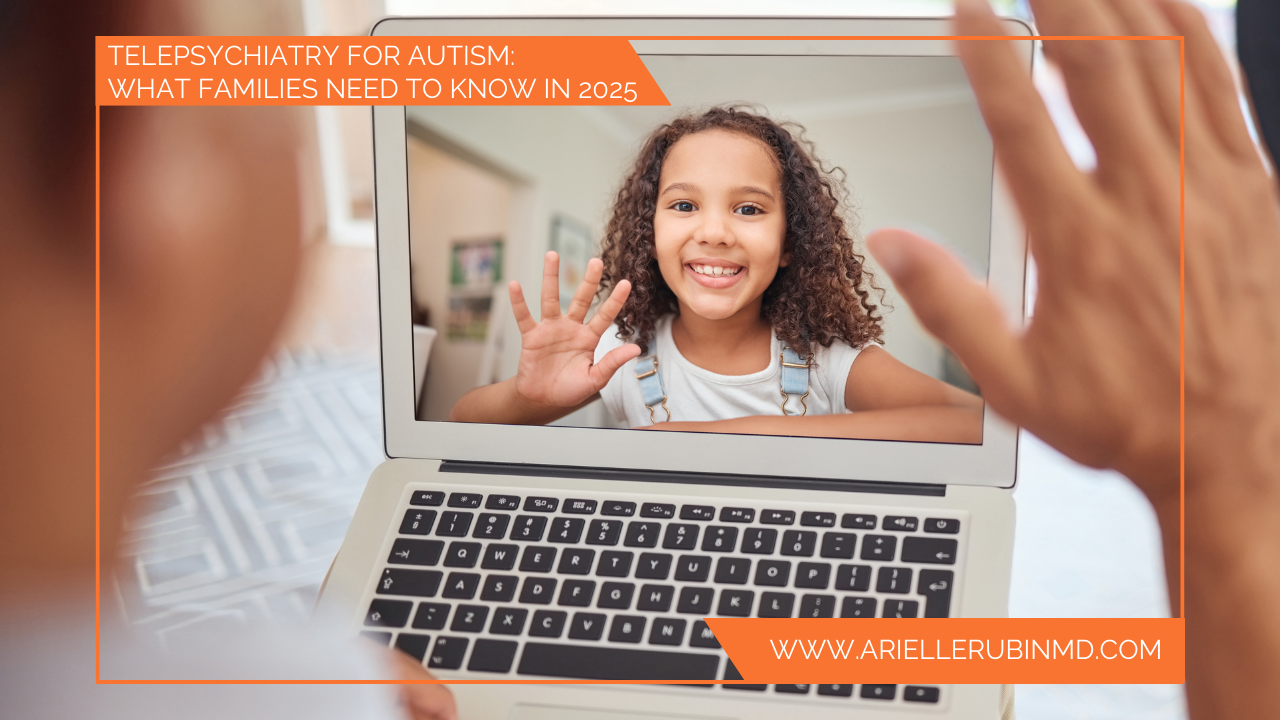
What I’ve Learned Providing Virtual Care to Autistic Children
(And why for many families, it’s not second-best — it’s better care)
Let me tell you about the moment I became a telepsychiatry believer.
It was early 2020, and I was on a video call with an 8-year-old autistic girl I'd been seeing for a few months.
In my office, she had always been:
- Stiff in her chair
- Brief, careful answers
- Polite smiles that never reached her eyes
- What I now recognize as textbook masking
But on this particular video call from her bedroom:
She started the appointment sitting at her desk. Within five minutes, she'd migrated to the floor. Then to her beanbag chair. Then back to the floor, this time lying on her stomach, legs kicking absently in the air.
Her hands moved constantly—flapping when she got excited about something, fidgeting with a small toy dinosaur.
She interrupted our conversation twice to show me her rock collection.
And she smiled. Really smiled.
Her mom looked at me through the screen with tears in her eyes.
"This is who she actually is," she said quietly. "This is my daughter when she doesn't have to perform."
My Dad Knew This Decades Ago
Here's something you might not know about me:
My father is also a psychiatrist. And long before telemedicine was mainstream, before COVID made it a household term, he was training resident physicians on how to deliver psychiatric care remotely.
I remember him talking about reaching patients hundreds of miles away in rural communities. Patients who would never have accessed psychiatric care otherwise.
"Technology," he'd say, "lets us bring care to where people actually live."
At the time, I thought he was just talking about geography.
Now I realize he was talking about something bigger:
Bringing care to where people can actually be themselves.
For autistic children, that place isn't usually a medical office.
When I first began offering telepsychiatry for autistic children, I wasn’t skeptical — I was curious. My dad, also a psychiatrist, had started training resident physicians on telemedicine long before it became mainstream. Watching him reach patients hundreds of miles away, I thought, what a powerful way to deliver care where it’s needed most.
Years later, as I began building my own autism-focused telepsychiatry practice, I wondered if virtual care could help children and families in the same way. And what I discovered changed everything.
When Families Don’t Have to Fight Logistics
Parents who once felt too overwhelmed by the daily grind could finally access consistent psychiatric care.
Kids who masked heavily in office settings began showing me their authentic selves at home — the stimming, the smiles, the spontaneous joy.
Families in rural Arizona or small towns hours from the nearest specialist suddenly had the same level of autism-informed psychiatric care as those near Phoenix.
For many autistic children, virtual psychiatry isn’t “as good as” in-person — it’s often better.
The Research on Autism Telepsychiatry
Over a decade of studies shows that telehealth for autistic individuals is both safe and effective:
- Telepsychiatry outcomes are equivalent to in-person care for medication management and therapy, with satisfaction rates around 85–95 %.
- Diagnostic accuracy is strong — tele-assessments for autism show 80–88 % agreement with in-person evaluations 1.
- Access to mental-health care for children increased nearly 30-fold between 2019 and 2022 2.
- Parent-training and sleep interventions delivered virtually produced large improvements3.
- Hybrid programs — combining virtual follow-ups with in-person evaluations — work particularly well for teens and families in rural areas 4.
Virtual psychiatry is no longer an emergency workaround. It’s an evidence-based model of care that works.
Why Access to Autism Psychiatry Still Matters
Despite these advances, many families still can’t access any autism-specialized psychiatric care.
The barriers are real:
- Waitlists 6–12 months long
- Few specialists statewide
- Transportation challenges
- Sensory overwhelm in traditional offices
- Childcare barriers for siblings
Telepsychiatry removes most of these obstacles.
No commute.
No bright lights or medical smells.
No stressful waiting rooms.
Just compassionate, neurodiversity-affirming care — where your child feels safe and regulated.
What Virtual Autism Appointments Make Possible
When sessions happen at home:
- Parents can join from work or school pickups without missing pay.
- Children can engage from the comfort of familiar spaces.
- I can observe authentic behaviors — communication, play, self-regulation — in their natural environment.
That context often tells me more than what I’d see in a 30-minute office visit.
What Makes Telepsychiatry Work
After thousands of virtual sessions, here’s what I’ve learned about effective telepsychiatry for autistic children:
What Helps
✅ Parent observations of what’s better, worse, or the same
✅ Input from school and therapy teams
✅ Honest discussion about side effects or changes
What’s Not Required
🚫 A perfectly still child staring at the camera
🚫 Silence or structure
🚫 Ideal lighting or “professional” background
Your child can stim, wander, or play nearby — I can still gather excellent clinical information.
Nuance Matters
Telepsychiatry doesn’t look the same for every family. The right approach depends on your child’s age, communication abilities, and developmental profile.
- Teens often thrive virtually — they feel more in control and less self-conscious.
- Younger children or those with limited expressive language may benefit from a hybrid model, supplementing virtual visits with in-person developmental testing.
- Non-speaking children still gain value from virtual observation and parent coaching, even if diagnostic components happen face-to-face.
And while virtual models are powerful, some children just do better with more in-person support, and this is completely ok!
When Virtual Care Changes Everything
Telepsychiatry doesn't just make care more convenient.
It fundamentally changes who can access care and what that care looks like.
The single mom working two jobs who can do appointments during her lunch break instead of losing a day's pay.
The family in rural Arizona who no longer drives three hours each way to see me, spending $100 on gas and a full day away from work and school.
The child who melts down in medical offices but sits happily at the kitchen table eating goldfish crackers while we talk.
The teen who can finally be honest about his struggles because he's in his bedroom, not in a scary doctor's office.
The non-speaking child whose parents can show me videos of behaviors at home that I'd never see in a clinical setting.
This is what's possible when we bring care to where children actually are.
- Attention challenges making video engagement impossible
- Families who simply communicate better face-to-face
And that's completely okay.
Sometimes technology adds frustration instead of removing barriers. When that happens, in-person care is the better choice.
This is what thoughtful, compassionate care looks like: Knowing when to adapt instead of forcing every family into the same format.
How We Make It Work in Practice
Most families thrive with what I call the "flexible hybrid model":
Virtual works brilliantly for:
- Regular medication management follow-ups
- Parent consultation and coaching
- Care coordination with school and therapists
- Ongoing therapy for teens
- Check-ins between bigger appointments
In-person might be needed for:
- Initial comprehensive evaluations (sometimes)
- Complex diagnostic questions
- Certain assessments requiring hands-on observation
- Crisis situations
Many families do:
- Initial consultation virtually
- In-person evaluation if needed for diagnosis
- All follow-up appointments virtual
- Occasional in-person for specific needs
The point is flexibility. Meeting YOUR family where you are.
The Bigger Picture
For most autistic children and families, telepsychiatry offers not just convenience — but connection.
Research now shows that beyond medication:
- Parent-mediated telehealth interventions reduce parental stress 6
- Virtual social-communication therapies improve pragmatic language 7
- Online programs enhance sleep and physical activity in autistic adolescents 8
I’ve worked with patients where telehealth wasn’t the right fit — due to severe dysregulation, complex medical needs, attention challenges, or families who simply communicate better in person. Sometimes technology adds frustration instead of removing it — and in those cases, in-person psychiatry is absolutely the better choice.
That’s part of thoughtful, compassionate care: knowing when to adapt the model instead of forcing every family into one format.
The Bottom Line
My practice is primarily virtual because I’ve seen how beautifully it works for autistic children and families. But telepsychiatry isn’t one-size-fits-all — and I’ll always be upfront when I think in-person evaluation or follow-up is needed.
For most medication management, parent consultation, and ongoing psychiatric support, virtual care removes barriers and builds bridges.
Yet for others, being physically in the room — reading body language, sharing space, managing crises — is irreplaceable.
Both can be true. And part of good medicine is knowing which approach will serve your child best.
If you’ve been putting off psychiatric care because of distance, overwhelm, or sensory challenges — know this:Virtual care may be exactly what your family needs.
And I’m here to provide it — with honesty, flexibility, and deep respect for your child’s unique way of communicating and connecting.
Footnotes
- Hallett J et al., Research in Autism Spectrum Disorders, 2023 – tele-assessment diagnostic agreement ≈ 80–88 %. ↩
- Healthcare Finance News, 2023 – pediatric tele-mental-health visits up ~30-fold (2019–2022). ↩
- Liu X et al., J Child Psychol Psychiatry, 2023 – telehealth parent-training for sleep, effect size ≈ 0.83. ↩
- Shen X et al., Front Pediatr, 2024 – tele-parent support improved sleep + activity in autistic teens. ↩
- Stavropoulos K et al., Current Opinion in Neurology, 2024 – telehealth less ideal for high-complexity, non-verbal cases. ↩
- Allegra E et al., Front Psychiatry, 2018 – telehealth parent training ↑ empowerment & ↓ stress. ↩
- Jones S et al., Review J Autism Dev Disord, 2023 – virtual social-communication interventions ↑ pragmatic language. ↩
- Shen X et al., Frontiers in Pediatrics, 2024 – tele-based parental support improved MVPA & sleep quality. ↩
- Journal of the American Academy of Child & Adolescent Psychiatry, 2021 – ≈ 10 % of U.S. youth lack digital and in-person mental-health access. ↩
Get notified when new blogs are posted and get exclusive insights by joining my weekly newsletter!

